
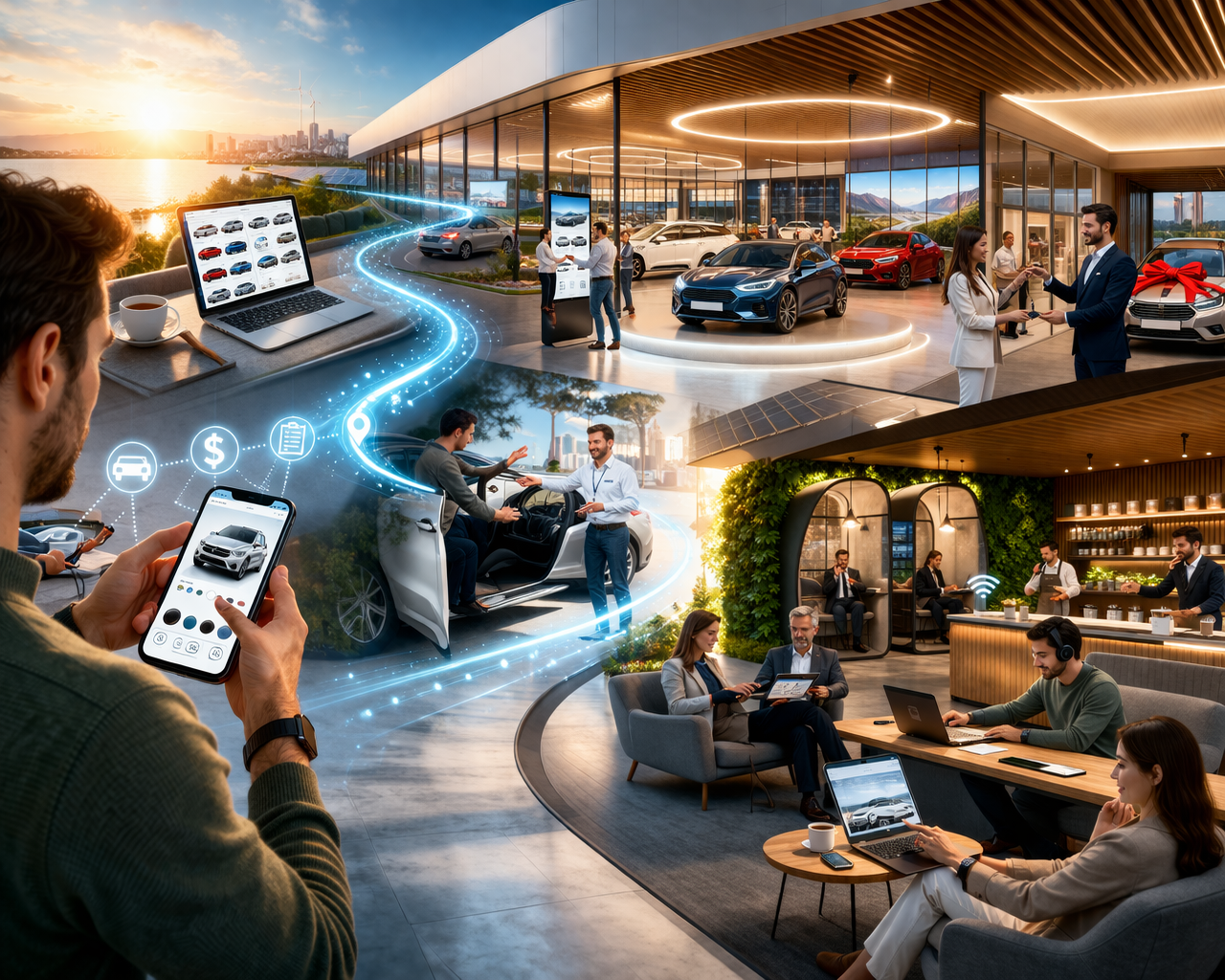
The vehicle purchase journey no longer begins at the dealership; it begins on the screen. Today, much of the research, version comparison, price analysis, and exploration of technologies happens before the customer even visits the store. In a recent McKinsey survey, nearly 60% of buyers said they rely exclusively on digital channels during the research and configuration stages. Even so, more than 85% say they want to take a test drive before purchasing, and half prefer to discuss the final details and place the order in person with a dealer.
This data helps explain why the rise of digital has not reduced the importance of the physical dealership; it has simply changed its role. The space is no longer where the customer “discovers” the car, but where they validate, experience, and build trust. In other words: digital accelerates the journey, but the physical environment remains decisive when the purchase needs to gain form, perception, and confidence.
This shift connects directly with the logic of the Experience Economy, a concept popularized by B. Joseph Pine II and James H. Gilmore in Harvard Business Review. The central idea is simple: in mature markets, companies do not compete only through products or services, but through their ability to create memorable and relevant experiences. In automotive retail, this means that the dealership can no longer be treated as a simple vehicle display point. It needs to function as a living extension of the brand.
This is exactly where the concept of Phygital comes in. More than installing screens or digitizing service steps, Phygital means designing a frictionless journey between online and offline. The strongest evidence of this appears in the most recent Cox Automotive study: 63% of buyers say the ideal experience combines online and in-person activities; only 28% prefer a fully online purchase, and just 7% actually completed the entire process that way. In addition, when steps such as credit approval and pre-filled documentation are completed before the visit, the customer saves an average of 42 minutes at the dealership. Among new-vehicle buyers who completed more than half of the steps online, 82% reported high satisfaction with the dealer experience.
In other words: the customer does not necessarily want “less dealership”; they want less friction. What creates value is not eliminating the physical space, but ensuring that it takes on a more qualified role. McKinsey itself has pointed out that dealerships need to evolve from points focused on contracts and service into more strategic functions, such as trusted advisors and product experience centers; environments where the brand guides, demonstrates, and welcomes, rather than merely transacts. The same study shows that around 70% of buyers still consider the dealership a key point for physically experiencing the vehicle, and 40% believe more transparent pricing and negotiation would be an important improvement to the experience.
This repositioning inevitably goes through architecture. When we talk about the showroom as an experience center, we are talking about an environment that needs to translate brand attributes into concrete perception. Lighting, materials, acoustics, layout, thermal comfort, product visibility, circulation flow, and delivery areas are no longer just operational details; they become conversion components. If the website informs, the physical space convinces. If the online comparator rationalizes the choice, the in-person environment transforms that choice into desire. This is the logic of sensory design applied to contemporary automotive retail.
Another decisive point is consistency across channels. Today’s consumer expects the experience to be continuous. In a global Salesforce survey with more than 16,000 consumers and business buyers, 69% said they expect consistent interactions across departments, and nearly 60% said they prefer fewer touchpoints to complete a task or obtain information. In the automotive sector, this means that the configuration completed online needs to appear during the in-person consultation, that the customer’s history must be integrated into the CRM, and that a conversation started in one channel cannot restart from zero in another. When this does not happen, technology stops simplifying the journey and starts creating frustration.
The need to strengthen customer bonds has also become more urgent. In the 2025 Global Automotive Consumer Study, Deloitte surveyed more than 30,000 consumers across 30 countries and found that the intention to switch brands is growing in several markets. In a scenario with more options and more brands, the physical space gains weight as a tool for differentiation, retention, and relationship building; especially when it can transform the visit into something useful, fluid, and aligned with the brand’s positioning.
In aftersales, this reasoning becomes even more strategic. The service experience remains one of the strongest drivers of loyalty. According to J.D. Power, when overall service satisfaction reaches 950 points or higher, 86% of mass-market brand customers and 88% of premium brand customers say they would “definitely” return to the dealership for paid services. At the same time, the 2026 study highlights a clear challenge: maintenance visits still take, on average, 1.61 hours for mass-market brands and 2.46 hours for premium brands — significantly longer than equivalent operations in the aftermarket.
That is why the waiting area is no longer a peripheral detail and has become part of the strategy. Also according to J.D. Power, convenience, communication, and consistent performance across key service indicators strongly increase satisfaction; yet only 26% of customers said they experienced nine or ten of the study’s key KPIs. The demand for greater transparency is also growing: 64% of customers want to receive photos or videos of their vehicle along with inspection results, but this is still delivered to only a minority.
In this context, the concept of Work Hubs makes increasing sense. In a CDK study with more than 2,000 respondents, 53% said they would be willing to wait in the dealership lounge during same-day services. More than 75% stated that a comfortable lounge is critical to overall satisfaction, and around half said they wanted dedicated work areas. This shows that the customer does not simply want to “wait” for the service; they want that time to be productive, comfortable, and compatible with their routine. Proper desks, accessible power outlets, strong Wi-Fi, call booths, quality coffee, and quieter environments are no longer perks; they become part of the aftersales value proposition.
Ultimately, Phygital is not about choosing between digital or physical. It is about making the two work together, with each one fulfilling its role more effectively. Digital reduces effort, organizes information, and anticipates decisions. The physical environment builds trust, reinforces positioning, and transforms the journey into an experience. For dealerships that want to remain relevant in the coming years, the challenge will not be merely incorporating technology, but redesigning their spaces so they respond to the real behavior of consumers — consumers who are more informed, more demanding, and less tolerant of friction.
In practice, this means thinking of the dealership as both a brand and performance asset: an environment capable of integrating data, service, product, aftersales, and relationship into one coherent experience. And it is precisely at this point that architecture, strategy, and operations stop acting separately and begin to build, together, a new role for automotive retail.
References used in the text: Harvard Business Review (Welcome to the Experience Economy), McKinsey, Deloitte, Cox Automotive, J.D. Power, Salesforce, and CDK Global.