
The US electric vehicle market is in the middle of a significant reset. After reaching a record 10.6% market share in Q3 2025 — driven by buyers rushing to claim the $7,500 federal tax credit before its expiration on September 30, 2025 — EV market share has settled at 5.8% through the first half of 2026, according to Cox Automotive data.
The correction is real, but it isn't a collapse. Used EV sales rose 12% in Q1 2026 with average transaction prices now within $1,300 of comparable gas vehicles — historically unprecedented near-parity. Kelley Blue Book EV shopping traffic actually increased in early 2026. The market wants EVs. What changed is the pricing math without federal subsidy.
Tesla remains the dominant player, accounting for approximately 50% of US EV sales in H1 2026. GM has firmed up second position after several quarters of legacy-brand movement. Ford has pulled back on EV production commitments. Rivian, Lucid, and other direct-sales manufacturers continue expanding despite headwinds.
State-level regulation is doing the work the federal framework is not. Seventeen states plus Washington D.C. have adopted California's Advanced Clean Cars II rule — a regulation requiring 35% ZEV sales in 2026, 68% by 2030, and 100% by 2035. Together these jurisdictions cover roughly 40% of US new car sales. The rule faces federal legal challenge from the current EPA, but automakers are investing in EV production regardless, because the rule is durable at state level.
Meanwhile, EV infrastructure investment continues advancing state by state — chargers, grid capacity, and building code updates that reflect the direction of travel even in a period of federal uncertainty.
Selling and servicing an EV isn't like selling and servicing an internal combustion vehicle. It requires materially different retail infrastructure.
A different service infrastructure. EV service bays need high-voltage safety equipment, battery lift capacity, specialized diagnostic tools, and technician certification. Traditional bay layouts often need to be redesigned.
Charging infrastructure on the property. Level 2 charging for customer deliveries and test drives, DC fast charging for demonstration and public access, and service-bay chargers for diagnostic work. This affects electrical capacity planning at the site level — often significantly.
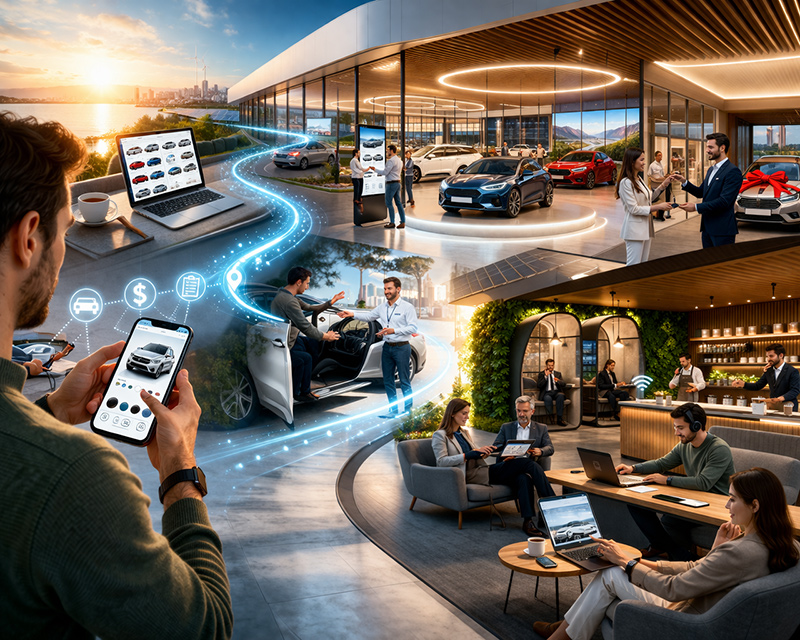
A different customer journey. EV buyers arrive with different questions — range, charging, battery lifecycle, home installation. The showroom experience benefits from education spaces, charging demonstration, and typically longer consultation time than combustion sales.
Updated brand standards from OEMs. Every OEM launching or refreshing an EV lineup is updating dealership design standards to reflect the new operational model. Standards current three years ago are being rewritten now.
For dealer groups, this often means retrofitting existing dealerships isn't enough — many sites need meaningful architectural rework to accommodate the operational reality of EV retail. For OEMs, it means brand standards need updating with EV-specific requirements: service bay specifications, charging placement, customer education zones, safety infrastructure.
At VC ONE, we've been designing EV-capable dealerships since the early stages of the transition. Our work with BYD across South America — designing over 250 dealerships from the ground up for an EV-first brand — gave us direct exposure to the design decisions that make EV retail work operationally. The insights transfer: how service flows change, where chargers belong architecturally, how showroom priorities shift when the product needs education alongside display.
The transition is real, correcting, and continuing to advance. The dealerships being designed today will need to serve customer expectations that are still forming under new pricing and policy conditions. The brand standards being written today will govern what dealership networks look like in 2030.
For OEMs and dealer groups navigating this shift, the strategic question is not whether retail infrastructure needs to evolve. It's how quickly, and how well.